Local Access Network Technologies

This text reviews the major new access technologies that are finding their way into significant use. It defines terms and technologies, and goes on to discuss how those technologies may be deployed.
 TABLE OF CONTENTS
 In previous sections the ADSL technology and the broadband products have been described. This section looks at the network design that supports the broadband services and describes the way in which the ADSL technology is implemented over the access connections to the users. It should be noted that the full end-to-end design covers the operational aspects of running a network as well as the network aspects. The operational design is covered in the next section.
The key components of the network design are shown in Figure 5.11. They consist of an ADSL user access network, a nationwide ATM network, and an IP network. The different broadband products use these networks in differing ways.
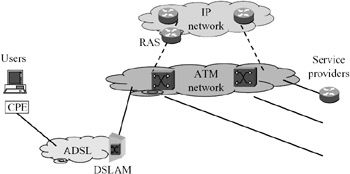
The general principles are quite straight forward. All users are connected to the ADSL network, which is terminated in the local exchange by the DSLAM connected to the ATM network. For ATM services, such as VideoStream and DataStream, traffic is simply carried across this network to the interface with the service provider.
For VideoStream, the purpose of the ATM network is to aggregate the traffic from the DSLAMs within the VideoStream footprints and present the aggregated traffic to a Point of Presence within the footprint. For DataStream, there is a similar purpose of aggregation, but the delivery of the traffic to the service provider's is not restricted to footprints.
For IPStream, the traffic is aggregated over the ATM network to a RAS that routes the IP packets across the...