Local Access Network Technologies

This text reviews the major new access technologies that are finding their way into significant use. It defines terms and technologies, and goes on to discuss how those technologies may be deployed.
 TABLE OF CONTENTS
 The introduction of ADSL (Asymmetric Digital Subscriber Line) to drive forward the interactive broadband revolution is now well underway. ADSL is providing consumers with unprecedented high speed access to the Internet, and has sufficient capacity to deliver video and high speed data to the majority of homes. But ADSL is not the end of the story; demand for bandwidth will continue to grow and telecommunications network operators are developing the ability to deliver capacity far beyond ADSL using an exciting new technology called VDSL (very high speed digital subscriber line).
Like ADSL, VDSL operates on existing telephony wire pairs and is therefore a natural step for network operators who own an extensive telephony infrastructure. The key difference between ADSL and VDSL is that VDSL relies on deployment of optical fibre deep into the access network to reduce the distance over which data has to travel on the wire pairs, thereby reducing cable losses and increasing capacity. Figure 6.1 shows the typical make up of the UK telephony access network.
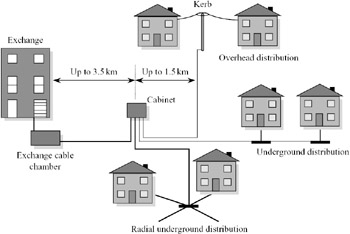
As can be seen in Figure 6.1, the topology of the UK telephony access network includes a number of flexibility points where cables are jointed and customer wire pair connections are managed. These flexibility points include the main distribution frame in the local exchange (MDF), underground joint chambers, primary crossconnect points (PCPs) known as cabinets , and distribution points (DPs) typically the final drop into the customer premises.
The UK...