Natural Gas Hydrates: A Guide for Engineers

Size of the Guest Molecule

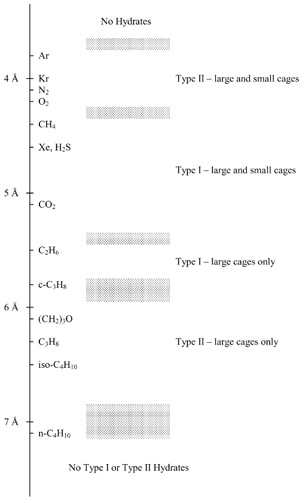
Von Stackelberg (1949) discovered the relationship between the size of a molecule and the type of hydrate formed. He plotted a chart (which is reproduced here, after some modifications, as Figure 2-2), showing the nature of the hydrate based on the size of the guest molecule.


Figure 2-2: Comparison of guest size, hydrate type, and cavities occupied for various hydrate formers. Modified from original by von Stackelberg, 1949

At the top of the diagram are the small molecules and the size increases as one goes downward on the chart. Hydrogen and helium are the smallest molecules, with diameters of only 2.7 and 2.3 , respectively (note 1 = 1 10 -10 m). From the chart it can be seen that molecules with diameters less than about 3.8 do not form hydrates.

As molecules increase in size (i.e., as we move down the chart), we come upon the first hydrate formers, which include krypton and nitrogen. There is a region bounded by two rather broad shaded marks; molecules with sizes in this range (from about 3.8 to 4.2 ) form Type II hydrates. These substances are sufficiently small such that they can occupy both the small and large cages of this hydrate structure.

Even farther down the chart is the next region (ranging from approximately 4.4 to 5.4 ), which includes methane, hydrogen sulfide, and carbon dioxide. Molecules with sizes in this range are Type I formers and are small enough to...

UNLIMITED FREE
ACCESS
TO THE WORLD'S BEST IDEAS

SUBMIT
Already a GlobalSpec user? Log in.

This is embarrasing...

An error occurred while processing the form. Please try again in a few minutes.

Customize Your GlobalSpec Experience

Category: Door Closers
Finish!
Privacy Policy

This is embarrasing...

An error occurred while processing the form. Please try again in a few minutes.