Natural Gas Hydrates: A Guide for Engineers

In the design of processes, physical properties are important. This is no less true when the processes involve hydrates. Some of the properties of hydrates were reviewed in previous chapters. This chapter focuses on properties that were not covered earlier.
The estimation of the properties of hydrates is complicated by the fact that the properties depend on (1) the type of the hydrate, (2) the guest molecule encaged in the hydrate, and (3) the degree of saturation (remember that hydrates are nonstoichiometric). It is unfortunate, but most hydrate programs do not give saturation numbers as part of their calculations. An exception is CSMHYD, which does give saturation values. The spreadsheet on the companion Web site can be used to estimate the saturation for pure components.
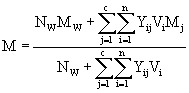
The molar mass (molecular weight) of a hydrate can be determined from its crystal structure and the degree of saturation. The molar mass of the hydrate, M, is given by:
| (8-1) | |
where N w is the number of water molecules per unit cell (46 for Type I and 136 for Type II), M w is the molar mass of water, Y ij is the fractional occupancy of cavities of type i by component j, v i is the number of type i cavities, n is the number of cavity types (2 for both Type I and II, but 3 for Type H), and c is the number of components in the cell.
Although this equation looks fairly...