Making Common Sense Common Practice: Models for Manufacturing Excellence

Of course, you can't simply make all the product possible, overstock on inventories, drive up costs, etc. However, what strategy should you employ? If capacity could be increased, could all of the additional product be sold? At what price? At what volume would prices have to be lowered to sell any incremental volume. What capacity (asset utilization rate, uptime) is needed to assure competitive position? Should we rationalize certain assets? And so on.
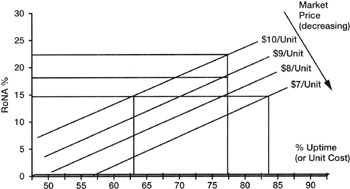
Figure 1-3 provides an easy way to map manufacturing performance with market conditions and quickly judge its impact on financial performance. It plots return on net assets (or gross margin/profits) as a function of uptime (and/or unit costs) for given market prices. For this chart, the logic goes something like this. For a given plant, you could determine what your current asset utilization rate or uptime is. For that uptime, and when combined with current operating costs, you could also determine what your current unit cost of production is for a given product set. With a large number of products this may get a little more difficult, but some companies use the concept of equivalent product units (EUs) for this purpose. For a given unit cost, and in a given market condition (price) you could also determine gross profit, and subsequently return on net assets (RoNA). In fact, for a family of prices you could determine the uptime required to achieve a given RoNA.
Beta...