Building SANs with Brocade Fabric Switches

This reference functions as a set of instructions for actual SAN implementation and teaches how a well-crafted SAN can reward your organization.
 TABLE OF CONTENTS
 The keys to robust Fibre Channel deployment are the components that you use to build your network. By understanding these components, you can better design a robust, scalable network. Understanding the features and capabilities of your hardware will help you select and qualify the best equipment for your needs.
The most basic layer of your SAN is the physical layer, which includes your media and connector choices. There are a number of choices that are dependant on the primary purpose of your SAN. In selecting the type of media to use for your SAN, you have two choices: copper and optical. The distinct advantage of copper is that it is inexpensive compared to all types of optical fiber. The advantage of optical fiber is that it provides a reliable signal over a longer distance than copper. There are two types of fiber: single mode and multimode. The difference in the fibers is the diameter of the fiber. Smaller-diameter single mode can transmit at a far greater distance.
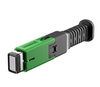
The cardinal rule for connecting a SAN is to minimize the total number of connections and patches. SC is the standard optical connector, but high-density connectors are becoming more popular as more devices are connected to SANs. Examples of high-density connectors are LC, MT-RJ, and HSSDC. HSSDC and DB-9 are the copper connectors available. In most SANs, you will need to use some types of GBICs. GBICs provide an easy way to adapt devices to whatever connection type...