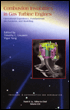
Combustion Instabilities in Gas Turbine Engines: Operational Experience, Fundamental Mechanisms, and Modeling
Kenneth O. Smith [*] and James Blust [ ]
Solar Turbines, Inc., San Diego, California
Copyright 2005 by the American Institute of Aeronautics and Astronautics, Inc. All rights reserved.
Gas turbine manufacturers have developed and continue to improve lean premixed (LP) combustion systems to meet emissions regulations for NOx, carbon monoxide, and unburned hydrocarbons. With LP combustion, high levels of combustion air are introduced into the gas turbine combustor primary zone (the flame zone) to produce a leaner fuel-air mixture than is typical of "conventional" diffusion flame combustors. The high airflow reduces the LP combustor flame temperature and, in turn, the NOx formation rate, which is an exponential function of temperature. A second characteristic of LP combustion is the mixing (or "premixing") of the fuel and air upstream of the primary zone. Premixing permits combustion of a uniform fuel-air mixture, thus preventing the locally high temperatures that can occur within a diffusion flame combustor.
The development of LP combustion-based products at Solar Turbines Incorporated...