Composing Music with Computers

This guide introduces a number of music composition techniques, and shows the key roles computers play in several aspects of music making.
 TABLE OF CONTENTS
 An iterative process is the repeated application of a mathematical procedure where each step is applied to the output of the preceding step (Figure 4.1).
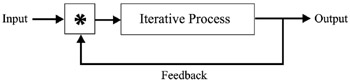
Mathematically, an iterative process is defined as a rule that describes the action that is to be repeatedly applied to an initial value x 0. The outcome of an iterative process constitutes a set, technically referred to as the orbit of the process; the values of this set are referred to as the points of the orbit. Thus, the orbit O that arises from the iterated application of a rule F to an initial value x 0 is written as: O F( x 0). For example, consider the following rule F: x n +1 = x n + 2. This rule indicates that the next value of the orbit x n +1 is calculated by adding the two units to the previous value. If one specifies that the initial value of x 0 is equal to zero, then the result of the iterated application of F onto x 0 will be O F(0) = {0, 2, 4, 6, }. This is certainly a very simple orbit, but iterative processes have the potential to produce fascinating orbits, some of which can be used to generate interesting musical sequences. Essentially, an iterative process...