Digital Image Processing, 6th Revised and Extended Edition

The neighborhood operations discussed in Chapter 4 can only be the starting point for image analysis. This class of operators can only extract local features at scales of at most a few pixels distance. It is obvious that images contain information also at larger scales. To extract object features at these larger scales, we need correspondingly larger filter masks. The use of large masks, however, results in a significant increase in computational costs. If we use a mask of size R W in a W-dimensional image the number of operations is proportional to R W. Thus a doubling of the scale leads to a four- and eight-fold increase in the number of operations in 2- and 3-dimensional images, respectively. For a ten times larger scale, the number of computations increases by a factor of 100 and 1000 for 2- and 3-dimensional images, respectively.
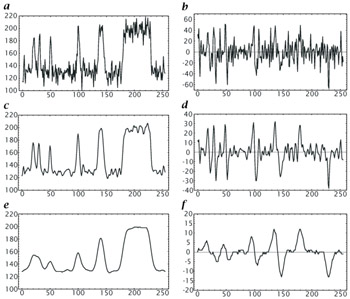
The explosion in computational cost is only the superficial expression of a problem with deeper roots. We illustrate it with a simple task, the detection of edges and lines at different resolutions. To this end, we use the same image row but blur it to different degrees (Fig. 5.1). We define the corresponding scale as the distance over which the image has been blurred and analyze the gray value differences over this distance.