Digital Image Processing, 6th Revised and Extended Edition

Chapter 3: Random Variables and Fields

3.1 Introduction

Digital image processing can be regarded as a subarea of digital signal processing. As such, all the methods for taking and analyzing measurements and their errors can also be applied to image processing. In particular, any measurement we take from images e. g., the size or the position of an object or its mean gray value can only be determined. with a certain precision and is only useful if we can also estimate its uncertainty. This basic fact, which is well known to any scientist and engineer, was often neglected in the initial days of image processing. Using empirical and ill-founded techniques made reliable error estimates impossible. Fortunately, knowledge in image processing has advanced considerably. Nowadays, many sound image processing techniques are available that include reliable error estimates.

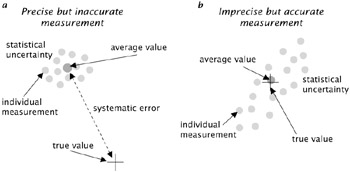
In this respect, it is necessary to distinguish two important classes of errors. The statistical error describes the scatter of the measured value if one and the same measurement is repeated over and over again as illustrated in Fig. 3.1. A suitable measure for the width of the distribution gives the statistical error and its centroid, the mean measured value.


Figure 3.1: Illustration of a systematic and b statistical error distinguishing precision and accuracy for the measurement of position in 2-D images. The statistical error is given by the distribution of the individual measurements, while the systematic error is the difference between the true value and the average of the measured values.

This...

UNLIMITED FREE
ACCESS
TO THE WORLD'S BEST IDEAS

SUBMIT
Already a GlobalSpec user? Log in.

This is embarrasing...

An error occurred while processing the form. Please try again in a few minutes.

Customize Your GlobalSpec Experience

Category: RF Power Detectors
Finish!
Privacy Policy

This is embarrasing...

An error occurred while processing the form. Please try again in a few minutes.