The Foundations of Digital Signal Processing: Theory, Algorithms and Hardware Design

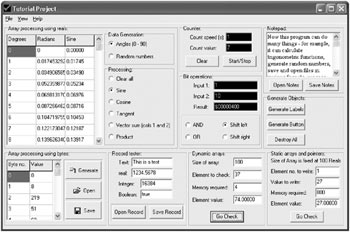
Whilst we cannot here discuss all the aspects of Delphi OOP and visual programming, we can at least cover those features that will be of most relevance to us as far as DSP is concerned. In other words, we will adopt a pragmatic rather than a strictly scientific approach to the subject. Now some computing purists might frown at this, but let us not worry too much about that; we only have limited space to discuss high-level programming in a meaningful way, so we need to arrive at the core of the matter as quickly as possible. If you look on the CD that accompanies this book, there is a folder called Applications for Chapter 3\ Tutorial Program\ where you will find a project called Tutorial_project.dpr, and its accompanying application, Tutorial_project.exe. This is the main application to which we will refer throughout most of the rest of this chapter, because it includes many key features and functions that DSP programmers will have recourse to at some stage. When running, Tutorial_project.exe might typically appear as shown in Figure 3.5.
Now this program can do many things for example, it can calculate trigonometric functions, generate random numbers, save and open files in various formats, process binary values, generate program objects, and even graph simple functions and produce animated displays. Some of these things it does well,...