3.2 MULTIPHASE FLOW TERMINOLOGY
This section defines the variables commonly used to describe multiphase flow. For example, the general pressure drop equation for multiphase (two and three phase) flow is similar to that for single-phase flow except some of the variables are replaced with equivalent variables, which consider the effect of multiphase. The general pressure drop equation for multiphase flow is as follows (Brill and Beggs, 1991):
where
where dP/dx is flow pressure gradient, x is pipe length, ? is flow density, V is flow velocity, f is friction coefficient of flow, D is internal diameter of pipeline, ? is inclination angle of pipeline, g is gravitational acceleration, and g c is gravitational constant. The subscripts are "tot" for total, "ele" for elevation, "fri" for friction loss, "acc" for acceleration change terms, and "tp" for two-and/or three-phase flow.
Due to different flow mechanisms for different flow patterns, the multiphase (two/three phase) flow parameters used in the aforementioned pressure gradient equations should be defined separately. Definitions for commonly used multiphase variables are described based on Figure 3-1. The ideal flow of three fluids is considered in Figure 3-1: water, oil, and gas. It is assumed that the water is heavier than the oil and flows at the bottom, while the oil flows in the middle and the gas is the top layer.
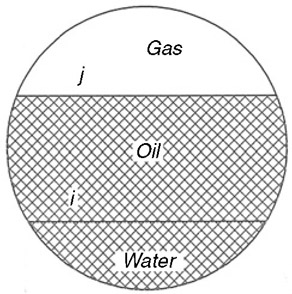 Figure 3-1: Three-phase flow pipe cross section (Taitel et al., 1995)
 3.2.1 Superficial Velocity
The superficial velocity is the velocity of one phase of a...

 TABLE OF CONTENTS