Handbook of Natural Gas Transmission and Processing
Nowadays line sizing of raw gas lines (i.e., wellhead to platform) is performed using integral reservoir deliverability conditions. However, the procedure is to specify the line size and predict the production profile. The maximum velocities are then checked to ensure that erosion-corrosion problems do not occur.
The primary sizing criterion for multiphase flow pipelines is erosional velocity, which should be kept below the known fluid erosional velocity. However, the sizing of pipelines for multiphase flow is significantly more complex than for single-phase flow because the resultant erosional conditions are totally dependent on the specific flow regimes. If sand production is considered, the situation is even more complex. In general, when considering erosion criteria, the flow velocity must be limited to the following conditions (Mokhatab, 2004).
For duplex stainless steel or alloy material:
328 ft/s in multiphase lines in stratified flow regimes (213 ft/s for 13% Cr. material).
66 ft/s in multiphase lines in annular, bubble, or hydrodynamic slug flow regime.
230 ft/s in multiphase lines in mist flow regimes.
For carbon steel material:
For continuous injection of corrosion inhibitor, the inhibitor film ensures a lubricating effect that shifts the erosion velocity limit. The corrosion inhibitor erosion velocity limit will be calculated taking into account the inhibitor film wall shear stress (Smart, 2001).
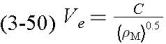
For injection of corrosion inhibitor, use Equation (3-50) to determine the erosion velocity (API RP 14E, 1991):
where V e is erosional velocity, ft/s; C is...