PIC Microcontrollers: Know It All

Featuring a presentation of theory, hard fact, and project-based direction, this reference will help average embedded engineers working with PIC microcontrollers solve a variety of real-life problems in this area.
 TABLE OF CONTENTS
 Keypads are an excellent way of entering data into the microcontroller. The keys are usually numbered, but they could be labeled as function keys for example, in a remote control handset in a TV to adjust the sound or color, etc. As well as remote controls, keypads find applications in burglar alarms, door entry systems, calculators, microwave ovens, etc. So there is no shortage of applications for this section.
Keypads are usually arranged in a matrix format to reduce the number of I/O connections. A 12-key keypad is arranged in a 3 4 format requiring 7 connections. A 16-key keypad is arranged in a 4 4 format requiring 8 connections.
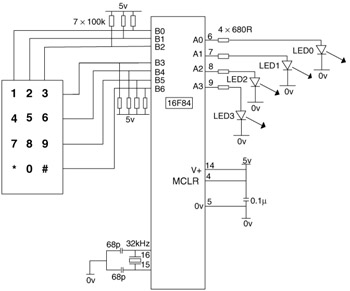
Consider the 12-key keypad. This is arranged in 3 columns and 4 rows as shown in Table 12.1. There are 7 connections to the keypad C1, C2, C3, R1, R2, R3 and R4.
| Column1, C1 | Column2, C2 | Column3, C3 | |
|---|---|---|---|
| Row1, R1 | 1 | 2 | 3 |
| Row2, R2 | 4 | 5 | 6 |
| Row3, R3 | 7 | 8 | 9 |
| Row4, R4 | * | 0 | # |
This connection to the microcontroller is shown in Fig. 12.1. The keypad works in the following way: If key 6 is pressed, then B2 will be joined to B4. For key 1, B0 would be joined to B3, etc., as shown in Fig. 12.1. The microcontroller would set B0 low and scan B3, B4, B5 and B6 for a low to see if keys 1, 4, 7 or * had been pressed.