Video Coding: An Introduction to Standard Codecs

From the ground up, this guide explains video coding algorithms to video compression systems, and more.
 TABLE OF CONTENTS
 Synthetic images form a subset of computer graphics, that can be supported by MPEG-4. Of particular interest in synthetic images is the animation of head-and-shoulders or cartoon-like images. Currently animation of synthetic faces has been extensively studied, and the three-dimensional body animation will be addressed in the second phase of MPEG-4 development.
The animation parameters are derived from a two-dimensional mesh, which is a tessellation of a two-dimensional region into polygonal patches. The vertices of the polygonal patches are referred to as the node points or vertices of the mesh. In coding of the objects, these points are moved according to the movement of the body, head, eyes, lips and changes in the facial expressions. A two-dimensional mesh matched to the "Claire" image is shown in Figure 9.19(a). Since the number of nodes representing the movement can be very small, this method of coding, known as model-based coding, requires a very low bit rate, possibly in the range of 1 10 bit/s [10].
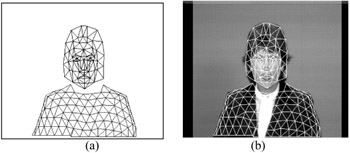
In order to make synthetic images look more natural, the texture of the objects is mapped into the two-dimensional mesh, as shown in Figure 9.19(b). For coding of the animated images, triangular patches in the current frame are deformed by the movement of the node points to be matched into the triangular patches or facets in the reference frame. The texture inside each patch in the reference frame is...