Video Coding: An Introduction to Standard Codecs
From the ground up, this guide explains video coding algorithms to video compression systems, and more.
 TABLE OF CONTENTS
 The success of the zero-tree in efficient coding of wavelet transform coefficients has encouraged researchers to use it for video coding. Although wavelet-based video coding is not part of the standard, here we show how the embedded zero-tree wavelet (EZW) can be employed in video coding.
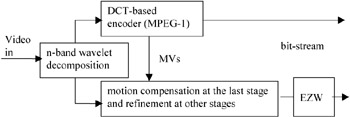
Figure 9.31 shows a block diagram of a video codec based on the wavelet transform. Each frame of the input video is transformed into n-band wavelet sub-bands. The lowest LL band is fed into a DCT-based video encoder, such as MPEG-1. The other bands undergo a hierarchical motion compensation. First, the three high frequency bands of the last stage are motion compensated using the motion vectors from MPEG-1. The reconstructed picture from these four bands (LL, LH, HL and HH), which is the next-level LL band, only requires a pixel refinement [21. The other three bands at this stage are also motion compensated by the same amount. This process is continued for all the bands. Hence at the end all the bands are motion compensated. Now, these motion compensated bands are coded with the EZW method.
When the EZW is used for video coding, with the lowest band to be coded with a standard codec, it meets some problems. First, the sub-band decomposition stops when the top-level LL band reaches a size of SIF/QSIF or sub-QSIF. At these levels there will be...