Cyclic Polymers, Second Edition

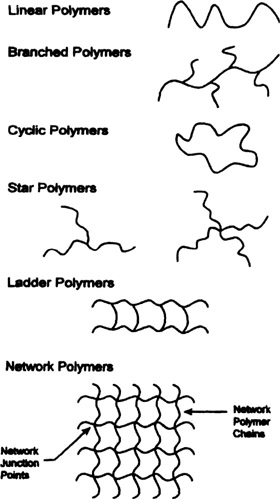
Polymers molecules may be prepared with a variety of architectural structures such as linear, ring, star, branched, ladder and dendritic chains and they may also be three dimensional network structures. Some of these molecular forms are illustrated in Figure 1. The first synthetic cyclic polymers to be prepared and characterized were the poly(dimethysiloxanes) (PDMS) which were reported in 1977 [1]. Since that time a number of other cyclic polymers have been synthesized which include cyclic polystyrene [2] , [3] , [4], cyclic poly(phenylmethylsiloxane) [5], cyclic poly(2-vinylpyridine) [6], cyclic polybutadiene [7] and cyclic poly(methylvinylsiloxane) [8].
In this overview, we will discuss some selected properties of cyclic polysiloxanes, particularly where large differences are seen when compared to the linear polymeric analogs. The area of topological entrapment of ring polymers into networks structures will also be described, which is an area that is not accessible to linear polymers unless they undergo end-cyclizing chemistry. This concept of topological threading is somewhat general for ring molecules as it may also be utilized in the preparation of catenanes and rotaxanes.
[2]G. Hild, A. Kohler and P. Rempp, European. Poly. J. 16, 525 (1980)
[3]D. Geiser and H. Hocker, Polym. Bull 2, 591 (1980); Macromolecules 13, 653 (1980)
[4]J. Roovers and P. M. Toporowski, Macromolecules 16, 843 (1983)
[7]T. E. Hogen-Esch and W. Toreki, Polymer Preprints (Am. Chem.