Cyclic Polymers, Second Edition

Cyclic polyesters were some of the earliest cyclic polymers to be prepared. Vorlander [1] in the 1890's prepared the cyclic dimer of ethylene succinate and Carothers [2] experimented with a range of 17 bond cyclic esters in an attempt to produce artificial musk for the perfume industry. Since then many cyclic esters have been synthesised. The synthetic approach to these cyclic polymers is outlined in the following section. The study of cyclic ether-esters is a newer field, with considerable work having been carried out by Bradshaw and co-workers in the 1970's. The synthesis of ether-esters is very similar to that of the esters as is shown in the following section. The characterisation of cyclic esters and ether-esters is discussed in relation to those polymers recently and currently being produced at the University of York, U.K. Finally, the application of cyclic esters and ether-esters is reviewed briefly and possible future applications are postulated.
There are a number of different methods of polyester macrocycle synthesis.
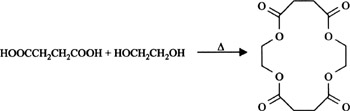
The earliest reported macrocyclic compound prepared from a dibasic acid was cyclic dimeric ethylene succinate which was described by Vorlander in 1894 [1]. This reaction is shown below in Figure 8.1.1-1. The same compound has subsequently been prepared by others [2] , [3] , [4].