Cyclic Polymers, Second Edition

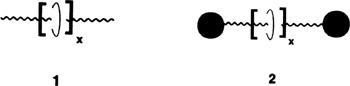
Since the first experimental evidence appeared over 30 years ago, the field of rotaxanes has grown considerably. The name rotaxane is derived from the Latin words for wheel and axle , [1] and describes a compound that consists of a linear and cyclic species bound together in a threaded structure by non-covalent forces. A low molar mass rotaxane is depicted by structure 1. To prevent diffusional loss of the cyclic species, bulky groups, often called blocking groups , knots , or stoppers , are attached to the ends of the linear component. The resulting structure 2 is the typical representation for a rotaxane. Although structure 1 also meets the definition for a rotaxane, it is now commonly referred to as a pseudorotaxane because of its potential to disassemble to the individual cyclic and linear components. The composition of the rotaxane is indicated with a number in a bracket, a method of nomenclature reported by Stoddart some time ago. [2] Thus, 2 (x=1) is a [2]rotaxane; the "2" designates the total number of species involved. So, 2 (x=2) is a [3]rotaxane, 2 (x=3) is a [4]rotaxane, etc. This nomenclature, while convenient in simplicity, is ambiguous because a [3]rotaxane can also consist of two linear components in a single cyclic species, as discussed below.

Although discussion of rotaxanes may have taken place as early as 1900 [3]