Flexible AC Transmission Systems: Modelling and Control

Mathematically, as an example the objective function of a three-phase OPF may be minimizing the total operating cost as follows:
| (5.141) | |
while subject to the following constraints:
Nonlinear equality constraints:
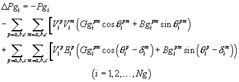
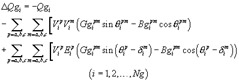
| (5.142) | |
| (5.143) | |
| (5.144) | |
| (5.145) | |
Inequality constraints:
| (5.146) | |
| (5.147) | |
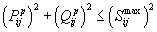
| (5.148) | |
| (5.149) | |
| (5.150) | |
where
| ? i, ? i, ? i | coefficients of production cost functions of generator |
| ? P i p | bus active power mismatch equations |
| | bus reactive power mismatch equations |
| | active line power flow |
| | Reactive line power flow |
| P g | the vector of active power generation |
| Q g | the vector of reactive power generation |
| ? g | the vector of generator internal bus voltage angle |
| V g | the vector of generator internal bus voltage magnitude |
| ? | the vector of bus voltage angle |
| V | the vector of bus voltage magnitude |
| t | the vector of transformer tap ratios |
| x = [Pg, Qg, ?g, Vg, t, ?, V] T is the vector of variables | |
| N | the number of system buses excluding the generator internal buses |
| N g | the number of generators |
| N t | the number of transformers |
The power flows
and
are given by:
| (5.151) | |
| (5.152) | |
In the three-phase OPF problem of (5.141) (5.150), the SSSC and UPFC mod-els with the extra equalities and inequalities, which have been presented in previous sections, can be included. The three-phase OPF problem may be solved by the nonlinear interior point methods that have been applied to the conventional OPF...