Formulas and Calculations for Drilling, Production and Workover: All the Formulas You Need to Solve Drilling and Production Problems, Second Edition
Casing pressure decrease when bringing well on choke
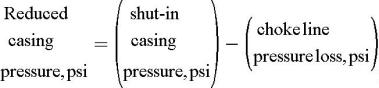
When bringing the well on choke with a subsea stack, the casing pressure (annulus pressure) must be allowed to decrease by the amount of choke line pressure loss (friction pressure):
Example: Shut-in casing (annulus) pressure (SICP) = 800 psi
Choke line pressure loss (CLPL) = 300 psi
Reduced casing pressure, psi = 800 psi ? 300 psi
Reduced casing pressure = 500 psi
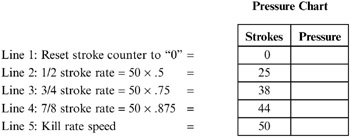
Pressure chart for bringing well on choke
Pressure/stroke relationship is not linear. When bringing the well on choke, to maintain a constant bottomhole pressure, the following chart should be used:

Strokes side:
Example: kill rate speed = 50 spm
Pressure side:
Example: Shut-in casing pressure (SICP) = 800 psi Choke line pressure loss (CLPL) = 300 psi
Divide choke line pressure loss (CLPL) by 4, because there are 4 steps on the chart:

Maximum allowable mud weight, ppg, subsea stack as derived from leak-off test data
Example: Leak-off test pressure = 800psi
TVD from rotary bushing to casing shoe = 4000ft
Mud weight in use = 9.2ppg
Maximum allowable mud weight, ppg = 800 0.052 4000 + 9.2
Maximum allowable mud weight = 13.0ppg
Maximum allowable shut-in casing (annulus) pressure
Example: Maximum allowable mud weight = 13.3ppg
Mud weight in use = 11.5ppg
TVD from rotary kelly bushing
to casing shoe = 4000ft
MASICP = (13.3ppg 11.5ppg) 0.052 4000ft
MASICP = 374
Casing burst pressure subsea stack