Handbook of Nuclear Chemistry: Basics of Nuclear Science, Volume 1

V.E.Viola
Department of Chemistry and IUCF, Indiana University, Bloomington, Indiana, USA
The investigation and application of nuclear reactions play a prominent role in modern nuclear chemistry research. In this chapter we initially describe the basic principles of nuclear energetics and reaction probabilities that govern collisions between nuclei. The final two sections then examine the various mechanisms that account for, first, reactions at low energies where quantal and equilibrium behavior dominate, and then at higher energies where much more complex phenomena occur.
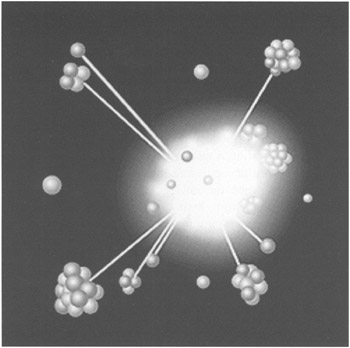
In recent years our understanding of nuclear reaction mechanisms has been significantly expanded by developments in accelerator technology, which now provide nuclear science with a highly diverse arsenal of nuclear projectiles. The accessible domain extends from ultra-cold slow neutrons to multi-GeV beams of heavy nuclei with energies capable of disintegrating a nucleus into its constituent nucleons and clusters (FIGURE 1), and perhaps even decomposing the nucleon itself into quarks and gluons. Not only is it possible to probe the nucleus with projectiles of naturally-occurring isotopes of elements ranging from hydrogen to uranium, but beams of photons, electrons, mesons, neutrons and antiprotons are also available. The range of phenomena under investigation has spanned the nuclear temperature domain from relatively cold nuclear systems to the nuclear vaporization limit, as well as the density profile from dilute to compressed nuclear matter.
In a broader perspective, progress in related...