Heat Pipes, Fifth Edition

2.2: OPERATION OF HEAT PIPES

2.2 OPERATION OF HEAT PIPES

2.2.1 Wicked Heat Pipes

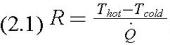
The overall thermal resistance of a heat pipe, defined by equation 2.1, should be low, providing that it functions correctly.

The operating limits for a wicked heat pipe, first described in [1], are illustrated in Fig. 2.1.


Figure 2.1: Limitations to heat transport in a heat pipe

Each of these limits may be considered in isolation. In order for the heat pipe to operate the maximum capillary pumping pressure, ?P c,max must be greater than the total pressure drop in the pipe. This pressure drop is made up of three components.

  1. The pressure drop ?P 1 required to return the liquid from the condenser to the evaporator.

  2. The pressure drop ?P v necessary to cause the vapour to flow from the evaporator to the condenser.

  3. The pressure due to the gravitational head, ?P g which may be zero, positive or negative, depending on the inclination of the heat pipe.

For correct operation,


[1]If this condition is not met, the wick will dry out in the evaporator region and the heat pipe will not operate. The maximum allowable heat flux for which equation 2.2 holds is referred to as the capillary limit. Methods of evaluating the four terms in equation 2.2. will be discussed in detail in this chapter. Typically, the capillary limit will determine the maximum heat flux over much of the operating range; however, the designer must check that a heat...

UNLIMITED FREE
ACCESS
TO THE WORLD'S BEST IDEAS

SUBMIT
Already a GlobalSpec user? Log in.

This is embarrasing...

An error occurred while processing the form. Please try again in a few minutes.

Customize Your GlobalSpec Experience

Category: Heat Pipes
Finish!
Privacy Policy

This is embarrasing...

An error occurred while processing the form. Please try again in a few minutes.