Heat Pipes, Fifth Edition

Chapter 4: Design Guide

4.1 INTRODUCTION

The design of a heat pipe or thermosyphon to fulfil a particular duty involves four broad processes:

Selection of appropriate type and geometry

Selection of candidate materials

Evaluation of performance

limits Evaluation of the actual performance

The background to each of these stages is covered in Chapters 2 and 3. In this chapter, the theoretical and practical aspects are discussed with reference to sample design calculations.

4.2 HEAT PIPES

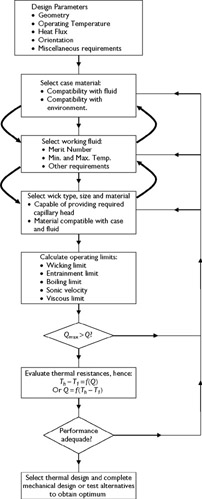
The design procedure for a heat pipe is outlined in Fig. 4.1.


Figure 4.1: Flow sheet for heat pipe design

As with any design process, many of the decisions that must be taken are inter-related and the process is iterative. For example, choice of the wick and case material eliminates many candidate working fluids (often including water) due to compatibility constraints. If the design then proves inadequate with the available fluids, it is necessary to reconsider the choice of construction materials.

Two aspects of practical design, which must also be taken into consideration, are the fluid inventory and start-up of the heat pipe.

4.2.1 Fluid Inventory

A feature of heat pipe design, which is important when considering small heat pipes and units for space use is the working fluid inventory. It is a common practice to include a slight excess of working fluid over and above that required to saturate the wick, but when the vapour space is of small volume a noticeable temperature gradient can exist at the condenser, similar to that indicating the presence of noncon-densable gas.

UNLIMITED FREE
ACCESS
TO THE WORLD'S BEST IDEAS

SUBMIT
Already a GlobalSpec user? Log in.

This is embarrasing...

An error occurred while processing the form. Please try again in a few minutes.

Customize Your GlobalSpec Experience

Category: Fluid Management Services
Finish!
Privacy Policy

This is embarrasing...

An error occurred while processing the form. Please try again in a few minutes.