High Voltage Engineering and Testing, 2nd Edition

5.4: Dampers and Spacer Dampers

5.4 Dampers and Spacer Dampers

5.4.1 Introduction

Transmission line conductors frequently vibrate, generally because of the action of wind blowing over the conductors. In this section, the causes of vibration and methods of minimising vibration levels are discussed.

5.4.2 Single Conductors

Single conductors exhibit two separate forms of vibration. The first, of small amplitude and high frequency, is known as aeolian vibration. The frequency of aeolian vibration is usually in the range of 5 to 100 Hz and with an amplitude of 0.5 to 2 conductor diameters. The wave motion is largely in the vertical plane. The second type of oscillation is called gal loping and this type of violent oscillation is most often, but not always, associated with ice-covered conductors.

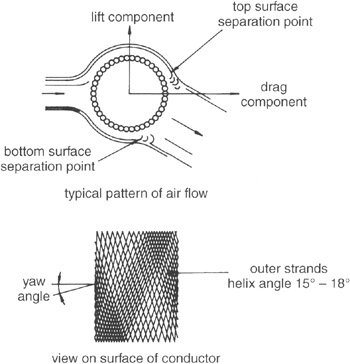
Aeolian vibration is generally caused by wind blowing 'normal' or up to an angle of about 75 to the conductor axis with a velocity of 2 km/h (0.55 m/s) to 32 km/h (8.8 m/s). When wind blows past a conductor at a velocity greater than the critical velocity, vortices begin to form on the leeward side of the conductor. The conductor, because of the helical form of the outer strands, will be subjected to either 'lift' or 'depression' and the direction of the force will depend on the 'yaw' angle of the wind and on the lay of the conductor. Figure 5.11 depicts the lift and drag forces developed by the action of wind on a single conductor.


Figure 5.11: Aerodynamic lift developed with stranded conductor

Aeolian vibration was...

UNLIMITED FREE
ACCESS
TO THE WORLD'S BEST IDEAS

SUBMIT
Already a GlobalSpec user? Log in.

This is embarrasing...

An error occurred while processing the form. Please try again in a few minutes.

Customize Your GlobalSpec Experience

Category: Wind Tunnel Testing Services
Finish!
Privacy Policy

This is embarrasing...

An error occurred while processing the form. Please try again in a few minutes.