High Voltage Engineering and Testing, 2nd Edition
J.S. Graham
A bushing is a device for carrying one or more high voltage conductors through an earthed barrier such as a wall or a metal tank. It must provide electrical insulation for the rated voltage and for service overvoltages and also serve as mechanical support for the conductor and external connections. The requirements for bushings are specified in IEC 60137 1995 [1].
Bushings are used to carry conductors into all types of electrical apparatus, e.g. transformers, switchgear and through building walls. Their form depends on the rated voltage, insulating materials and surrounding medium. Bushings can be broadly grouped into two types; noncondenser and condenser graded bushings.
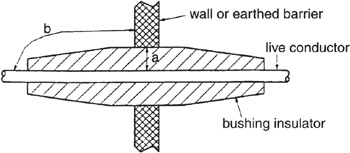
In its simplest form a bushing would consist of a conductor surrounded by a cylinder of insulating material, porcelain, glass, cast resin, paper, etc. as shown in Figure 12.1. The radial thickness a is governed by the electric strength of the insulation, and the axial clearance b by that of the surrounding medium.
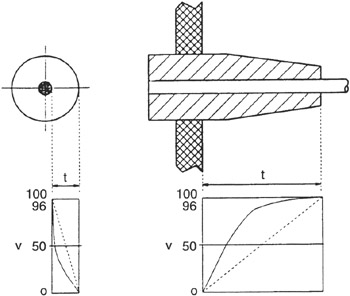
As shown in Figure 12.2, the electric stress distribution in such a bushing is not linear through the insulation or along its surface. Concentration of stress in the insulation may give rise to partial discharge and a reduction in service life. High axial stress may result in tracking and surface flashover. As the rated voltage increases, the dimensions required become so large that this form of bushing is not a practical proposition.