An Introduction to the Mathematics and Methods of Astrodynamics, Revised Edition
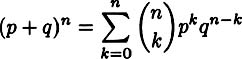
Not until eight years after james bernoulli died in 1705 was his main work, the Ars Conjectandi, published. This was the first significant book on probability and the most important new result that it contained is still named for Bernoulli. Specifically, if p and q are the respective probabilities that a single event will or will not occur, then the probability that this event will occur at least m times in n trials is the sum of the terms in the expansion of ( p + q) n from the term involving p m q n-m to p n. Indeed, the k th term in the binomial expansion
is the probability that the event in question will occur exactly k times in the n trials. The "trials" are called Bernoulli trials.
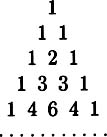
The binomial expansion, for positive integral n, was familiar to the Arabs of the thirteenth century. The term "binomial coefficient" was first introduced by the German mathematician Michael Stifel (1486?-1567) and the pattern of integers
in which each number is the sum of the two immediately above it, was used by Blaise Pascal (1623-1662) in 1654 to obtain these coefficients. Although this arrangement was known to many of his predecessors, including both Stifel and Tartaglia (who is famous for his solution of the cubic equation), it is, nevertheless, called "Pascal's triangle" since he derived from it the greatest number of applications which he published...