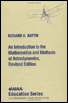
An Introduction to the Mathematics and Methods of Astrodynamics, Revised Edition
Appendix I: Miscellaneous Problems

This appendix consists of a collection of problems on guidance and navigation which, to the author, do not seem to fit naturally in the previous chapters. Some are examination questions and some are from the author's earlier book Astronautical Guidance.

Problem I-1

A spacecraft is in the plane of the ecliptic with the sun at the origin of coordinates. The earth is located on the x axis at a distance of one astronomical unit from the sun and the reference coordinates of the spacecraft are


To obtain a position fix, the distances from the sun and the earth are somehow measured. The measured distance from the sun is ?2 10 ?6 a.u. greater than expected while the measured distance from the earth is 10 ?6 a.u. greater than expected.

  1. Find the position deviation vector of the spacecraft from its reference position.

  2. If the measurements are assumed to be statistically independent with a standard deviation for each measurement of ? = 10 ?6 a.u., calculate the two-dimensional covariance matrix of the position estimation errors.

  3. Calculate the rms error, i.e., the square root of the mean-squared error, in the estimate of the position deviation from the reference point.

    A new estimate of position is made by adding a redundant third measurement of the angle between the earth and the sun as observed from the spacecraft.

  4. If the standard deviation of this angle measurement is ? = 10 ?6/

UNLIMITED FREE
ACCESS
TO THE WORLD'S BEST IDEAS

SUBMIT
Already a GlobalSpec user? Log in.

This is embarrasing...

An error occurred while processing the form. Please try again in a few minutes.

Customize Your GlobalSpec Experience

Category: LiDAR Sensors
Finish!
Privacy Policy

This is embarrasing...

An error occurred while processing the form. Please try again in a few minutes.