Introduction to Thermal Analysis: Techniques and Applications, Second Edition
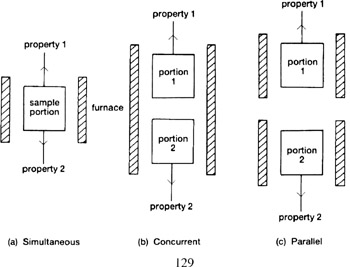
A truly simultaneous thermal analysis technique involves measurements of two or more of the properties in Table 1.1 on the same portion of the sample during a single temperature programme [1], [2]. Each of the properties may be monitored continuously, or they may be sampled in a repetitive sequence to allow for the requirements of data capture. Simultaneous measurements must thus be distinguished from parallel measurements, where different portions of the sample are examined using different instruments, and concurrent measurements where different portions of the same sample, in different containers, are held within a single furnace and are subjected to a common temperature programme, Figure 7.1. This last option is also used in instruments designed for carrying out one type of measurement on several samples. A simultaneous technique is usually written as the two acronyms linked with a hyphen, e.g. TG-DTA.
Results of the thermal analysis of a given sample, under a specified set of conditions, on a given instrument, are usually reasonably repeatable [3]. Agreement with the results on another portion of the same sample, obtained using the same technique on an instrument of a different make, or a similar instrument in a different laboratory, may be much less reproducible. It is even more difficult to compare results of parallel measurements from two or more independent thermal analysis techniques, e.g. TG and DTA. The advantages of...