Introduction to Thermal Analysis: Techniques and Applications, Second Edition
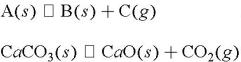
When a solid sample is heated, one of the many possible changes which it may undergo, is decomposition (see Table 2.1). Information on the kinetics and mechanisms of solid decompositions is of both practical and theoretical importance [3], [4]. For a heterogeneous reaction of the type:
the concept of reactant (or product) concentration does not play the significant role that it does in homogeneous reactions and the progress of reaction has to be measured in some other way. Usually the fractional reaction, ?, is, defined in terms of the change in mass of the sample ( ? = ( m o- m)/( m o- m f)) where m is the mass at that stage, m o is the initial mass and m f the mass of the sample when reaction is complete), or equivalent definitions in terms of amounts of gas evolved or heat absorbed or evolved.
? has to be carefully defined in relation to the reaction stoichiometry. Serious problems of definition may arise if the composition of the products varies with the extent of reaction, or if the gaseous products of a reversible reaction are not being effectively and completely removed from the neighbourhood of the sample, or if the reactant melts or sublimes.
Several other factors, which have no analogy in homogeneous reactions, have to be taken into account when solids are involved as reactants and/or products. These include possible variations in...