Magnetic Microscopy of Nanostructures

7.2: Instrumentation

7.2 Instrumentation

7.2.1 Basics: Secondary Electron Emission

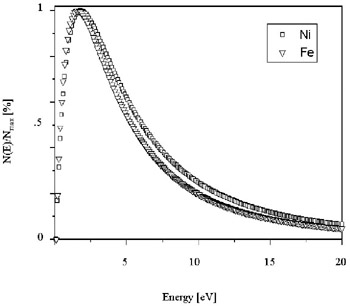
We will use the intensity distribution and the spin polarization of the secondaries to work out some general features for a SEMPA system (always concentrating on the case of Fe). The intensity distribution of the secondary electrons is well known from scanning electron microscopy [37]. The energy dependence is described by an analytic function:


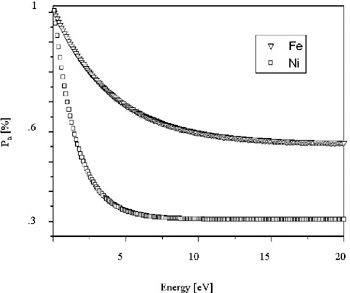
with E the energy of the secondaries and ? the work function of the material. N(E) is plotted for Ni and Fe in Fig. 7.2. Energy resolved spin polarizations have been measured for Fe, Co, Ni, and also alloys [38] [40]. In all cases there is a strong spin polarization enhancement at very low energies. In Ni [40] this feature is very sharp, while in Fe it is much broader [41]. As P(E) depends on the excitation energy [42], we chose measurements for excitation energies well above 1000 eV. Figure 7.3 shows a fit according to


Figure 7.2: Intensity distribution of secondary electrons. The graph is normalized to the value of the maximum of the distribution. The work function for Fe (Ni) are 4.5 eV (5.15 eV), taken from [123]

Figure 7.3: Normalized secondary electron polarization. The curves are obtained by fitting experimental curves from [40] , [41]. For P n = P/ P 0 ( P 0 = is the polarization at zero energy) and the energy dependence P n(

UNLIMITED FREE
ACCESS
TO THE WORLD'S BEST IDEAS

SUBMIT
Already a GlobalSpec user? Log in.

This is embarrasing...

An error occurred while processing the form. Please try again in a few minutes.

Customize Your GlobalSpec Experience

Category: ESR/EPR Spectrometers
Finish!
Privacy Policy

This is embarrasing...

An error occurred while processing the form. Please try again in a few minutes.