Pressure Vessel Design: The Direct Route

Like in the preceding annexes, the following examples are intended to illustrate the procedure, modelling, problems, and solutions, in one specific design check, here the stability design check. Therefore, these examples deal solely with individual load cases that are related to this design check.
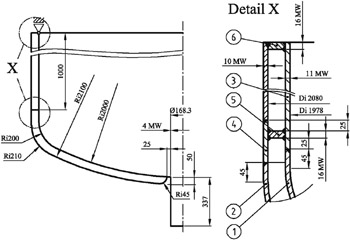
This example deals with one load case of a dished lower end of a jacketed stirring vessel, with geometry shown in Fig. E.6.1-1.
The geometry shown in this figure is the one of the model.
Maximum/minimum allowable pressure: [9]
PS = 4/-1 bar for the inner vessel; PS = 4 bar for the jacket
Maximum allowable temperature: [9]
TS = 152 C for inner vessel and jacket
Material:
EN 10028-7: X6CrNiTi18-10
Thickness allowances:
Corrosion/erosion: c = 0,
Tolerances: ? e = 0
Fabrication tolerances:
According to EN 13445-4
Insulation:
Yes
Thermal transients are slow enough such that non-stationary thermal stresses can be neglected
NOLC 3.1:
(Relevant) characteristic values of pressure:
Inner vessel:
=0
Jacket:
=0.42 MPa of which 0.02 MPa due to static head
(Relevant) characteristic values of temperature:
Inner vessel:
=152 C
Jacket:
=20 C
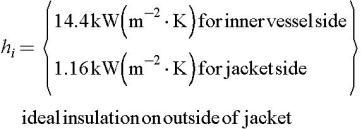
Heat transfer coefficients:
The corresponding load case specification, with derivation details, is given in Table E.6.1-1.
| NOLC 6.1: |
|---|