Process Modelling for Control: A Unified Framework Using Standard Black-box Techniques

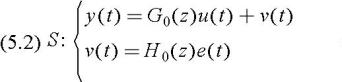
Let us assume that the true process is the SISO LTI system described by (2.79)
where, as usual, G 0( z) and H 0( z) are unknown discrete-time rational transfer functions, with G 0( z) strictly proper and H 0( z) stable and inversely stable. We shall further assume that ?( t) is zero-mean wide-sense stationary noise, e( t) being a white noise signal. Prediction-error identification theory requires no additional assumptions on the noise ?( t); in particular ?( t) does not need to be Gaussian: see (Ljung, 1999).
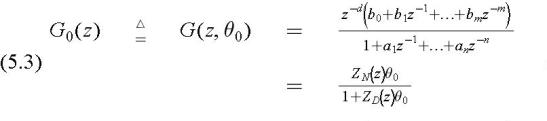
A polynomial representation of G 0( z) is given by
where
d is the dead time of the process;
is the vector containing the parameters of the true system;
is a row vector of size q;
Z n( z) = [0 0 z ?1 z ?2 z ? m] is a row vector of size q.
If the true system is not LTI, the theoretical derivations of this chapter are no longer valid. Indeed, they are based on the identification of an unbiased estimate of the system using prediction-error identification and on the construction, from the covariance of this estimate, of a frequency-domain uncertainty region containing the true system. The presence of a small amount of nonlinearities will however probably not destroy the ground...