Process Modelling for Control: A Unified Framework Using Standard Black-box Techniques

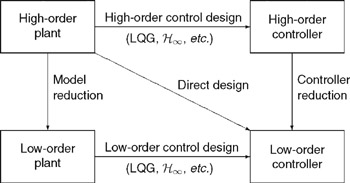
In many practical applications, low-order controllers are preferred to high-order ones for numerous reasons ( e.g., ease of implementation or maintenance, numerical robustness, etc.). However, it often happens that the design has to be carried out on the basis of a high-order model of the plant obtained by methods like physical (white-box) modelling, finite-element modelling, linearisation of a high-order nonlinear simulator, etc. In this case, three approaches can be considered for the design of a low-order controller (Obinata and Anderson, 2000), as depicted in Figure 6.1. The direct approach, which would evidently be the most appealing a priori, suffers several major problems: it involves very complicated equations with no intuitive content which may present a very great number of solutions; solving these equations is far from straightforward; there is no commercial software available for the direct computation of a model-based low-order controller for a high-order plant. Examples of direct methods can be found in (Bernstein and Hyland, 1984) and (Gangsaas et al., 1986). On the contrary, the two indirect methods, on which this chapter focuses, involve a step of model or controller reduction and a step of control design for which efficient, well understood and very popular tools and software packages are available. Examples of such tools are
and LQG for control design, and balanced truncation and Hankel-norm approximation for model or controller order reduction.