Process Modelling for Control: A Unified Framework Using Standard Black-box Techniques

In order to illustrate further the theory developed in this chapter, we now propose two realistic case studies where the complete validation procedure is applied and where open-loop and closed-loop results are compared.
Our first illustration is representative of control applications of flexible mechanical structures subject to step disturbances. It is based on a benchmark proposed by I.D. Landau in a special edition of the European Journal of Control in 1995 (Landau et al., 19956). We illustrate the fact that, for control-oriented validation, a closed-loop experiment with a flat reference spectrum typically yields a smaller worst-case ?-gap and an uncertainty region that leads to less conservative control designs than an open-loop experiment with a similar flat input spectrum.
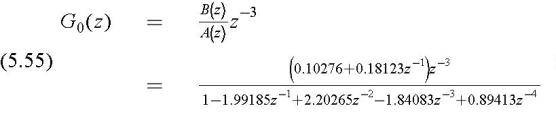
We consider as true system the half-load model of the flexible transmission system used in the benchmark study (Landau et al., 1995 b):
The output of the system is subject to step disturbances filtered through
One of the major specifications of the benchmark was that the designed controllers should ensure rejection of step output disturbances filtered by
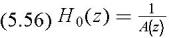
within 1.2 s (the sampling period being 0.05 s). This means that the plant can be seen as a nonstandard ARX system described by
where ? ?( t) is the input of the plant, y( t) its output and p( t) a sequence of step disturbances with zero mean...