Satellite Thermal Control for Systems Engineers

IV: Heat Pipes

IV Heat Pipes

Heat pipes greatly improve heat sharing in a satellite at a relatively small increase in weight. Their operation involves change of phase, with large heat rates transferred at an almost constant temperature. Hence, they dampen temperature differences in mounting and radiating panels and moderate the temperature in regions of concentrated heat sources or sinks.

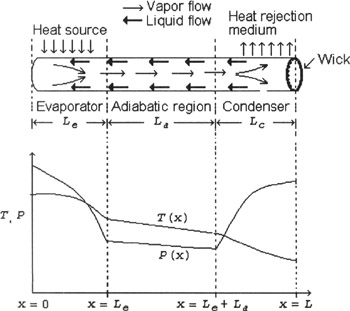
The basic heat pipe is schematically shown in Fig. 6.8. It is a tube in which an interior capillary wick (grooves, mesh, sintered porous material, etc.) is soaked with liquid and the container sealed at saturation conditions. As heat is applied to one end (the evaporator), a differential pressure is created and the vapor is driven to the cooler end (the condenser), where it condenses back into the wick. But because of liquid loss at the evaporator, the meniscus there depresses, resulting in a capillary head that drives the condensate back, which forces the process to repeat.


Figure 6.8: Basic heat pipe: the temperature is nearly constant in the adiabatic region and may be calculated from

As the driving potential is capillary action, a heat pipe is a natural for microgravity applications without assistance from mechanical pumps or other moving devices.

Variations on the concept include the variable conductance heat pipe [(VCHP) (Sec. IV.H of this chapter)] and the heat pipe diode. As shown in Fig. 6.9, the condenser end of the VCHP entails a reservoir of noncondensable gas whose front moves into and out of the active section following pressure changes with...

UNLIMITED FREE
ACCESS
TO THE WORLD'S BEST IDEAS

SUBMIT
Already a GlobalSpec user? Log in.

This is embarrasing...

An error occurred while processing the form. Please try again in a few minutes.

Customize Your GlobalSpec Experience

Category: Heat Pipes
Finish!
Privacy Policy

This is embarrasing...

An error occurred while processing the form. Please try again in a few minutes.