Satellite Thermal Control for Systems Engineers

Louvers are mechanical devices that, in effect, regulate the area of a radiator in response to its temperature. The regulation is preset to accommodate a wide range of heating within a relatively small change in temperature.
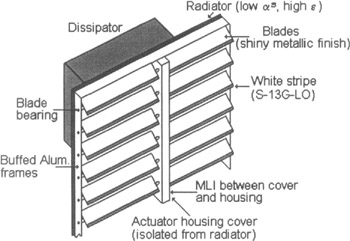
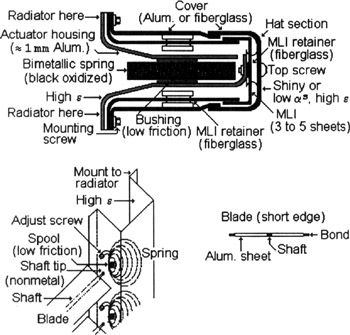
The louvers set used most is the venetian blind, shown in Fig. 6.25. It is a framed array of highly reflective blades, with central shafts that fit tightly into the center of bimetallic spring actuators calibrated to expand or contract to various angular positions at prescribed temperatures. The actuators are enclosed within an actuator housing (Fig. 6.26), which is thermally coupled to the radiator but protected and isolated from the external environment by a housing cover. As radiator heating increases, the rise in the temperature within the housing warms up the actuators, which then generate thermal torques that rotate the blades toward their open position leading to an increase in radiation to space. When the radiator temperature decreases, the actuators move the blades toward their closed positions, blocking more of the radiator's view to space and increasing the resistance to radiation. This automatic opening and closing of blades compensates for changes in dissipation and environment heating and keeps the temperature within a narrow band.
Reference [52] is a standard source with test data on venetian blinds louvers. The following is an updated and expanded version of that work. Brochures and design details may also be obtained from Orbital Sciences...