Space Modeling and Simulation: Roles and Applications Throughout the System Life Cycle

There are more things in Heaven and Earth, Horatio, than are dreamt of in your philosophy.
-Shakespeare, Hamlet
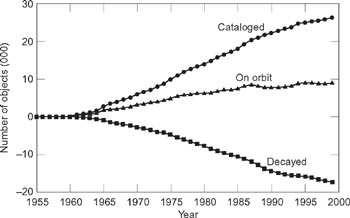
Since the beginning of the space age, humans have found purpose in exploring and exploiting space, but history has often shown that when we explore a new region, we leave residue of our presence. Space is no different. Since the launch of Sputnik 1 in 1957, the U.S. Space Surveillance Network (SSN) has cataloged more than 26,400 objects in space. Now the SSN is tracking some 8900 cataloged objects (NASA 2001). The catalog includes active spacecraft and space debris. Figure 14.1 shows the historical trends of space objects launched (including debris), decayed, and remaining in space.
Space debris is any artificial object that no longer has a function but continues orbiting Earth. This definition distinguishes space debris from working operational payloads and natural meteoroids that pass through Earth's orbit. The key question raised by space debris is: What is the likelihood that a given spacecraft will be damaged by colliding with another object? Space-mission planners must address...