Understanding IPv6

Based on the latest IETF meetings, this text provides professionals with a practical and detailed reference and introduction that explains the new capabilities and changes of the next-generation internet protocol.
 TABLE OF CONTENTS
 It is hard to predict when IPv4 address will be exhausted and when we are able to stop using IPv4. However, we definitely can say that we can not move on IPv6 in a day. Instead, IPv4 and IPv6 will exist together for a significant amount of time through transition mechanisms.
In the early stage of evolution to IPv6, we need to consider the environment where isolated IPv6 domains communicate each other in IPv4 network surroundings. To route packets in this environment, we need to consider how well to forward IPv6 data from a source to a destination nodes through IPv4 network. [1]
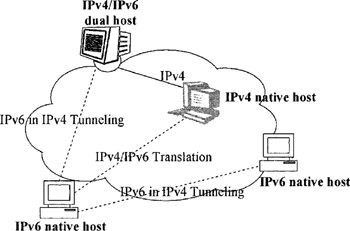
Various interconnection mechanisms provide interoperability between IPv4 and IPv6 entities throughout the IPv4/IPv6 mixed network environment. They may be classified into two groups; tunneling mechanisms and translation mechanisms as shown in Fig. 8-1. Tunneling mechanisms help isolated IPv6 nodes or IPv6 sites to communicate over IPv4 networks, and translation mechanisms allow IPv4 and IPv6 nodes to communicate. [2] Gradual deploying of IPv6 while providing uninterrupted IPv4 services is expected to happen. In this chapter, these interconnection mechanisms are explained in detail. Necessary terminology will be explained in the next section.
[1]F. Baker, E. Lear E, and R. Droms, Procedures for Renumbering an IPv6 Network without a Flag Day, work in progress (February 2004).
[2]Microsoft, IPv6 Deployment Strategies, Microsoft Corporation (December 2002).
Following node types should be understood before starting analysis of...