Understanding IPv6

Based on the latest IETF meetings, this text provides professionals with a practical and detailed reference and introduction that explains the new capabilities and changes of the next-generation internet protocol.
 TABLE OF CONTENTS
 Binding Update and Binding Acknowledgement messages are also used for the binding update process to the home agent. However, binding update to the home agents must use IPsec for the authentication and the integrity checking of these messages. Thus, IPsec should be implemented in both of the mobile node and the home agent. Both two communication entities should use Encapsulating Security Payload Header (ESP), [10] and further non-NULL payload authentication algorithm should be used to ensure robust security. Besides, Authentication Header (AH) can be employed. Binding update process is drawn in Fig. 10-6.
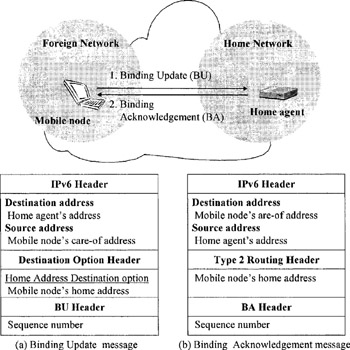
When a home agent receives a Binding Update message, it should verify and authenticate the message. Following tests are necessary for the binding update, as shown in Fig. 10-7:
If the home agent function is not implemented in a receiving node, it should reject Binding Update messages and return Binding Acknowledgement messages, where the State field is set to 131 to indicate that home registration is not supported.
If the home address in the Home Address option of Binding Update message is not on-link IPv6 address, i.e., the home address does not have home agent's current prefix (or prefixes), then the home agent should reject the Binding Update message and return a Binding Acknowledgement message, where the State field is set to 132 to indicate the invalid home subnet prefix.
If any other reasons are found...