Understanding IPv6

Based on the latest IETF meetings, this text provides professionals with a practical and detailed reference and introduction that explains the new capabilities and changes of the next-generation internet protocol.
 TABLE OF CONTENTS
 Correspondent registration is a registration between a mobile node and a correspondent node, and it is achieved via two steps; return routability procedure and binding update process. Strictly speaking, correspondent registration procedure is performed after return routability procedure, but here correspondent registration is used as a unified terminology for the simplicity.
While authentication infrastructure between a mobile node and its home agent is required for home registration, return routability process is used to verify that the sender is a proper mobile user. Return routability process does not protect communication parties from attackers who are present between them; however, it is very effective to preclude counterfeit Binding Update message from non-right users and to limit attackers who lie on a specific path.
Keyed-hash algorithm is used in MIPv6 to protect integrity and authenticity of the Binding Update messages. The key for the algorithm, called binding management key (Kbm), is obtained by data exchange during the return routability process. Besides, node keys, Nonces, Cookies, Tokens, and cryptographic functions are used for the return routability. Once return routability procedure finishes successfully, binding update process starts. These sequential procedures are shown in Fig. 10-8 and 10-9.
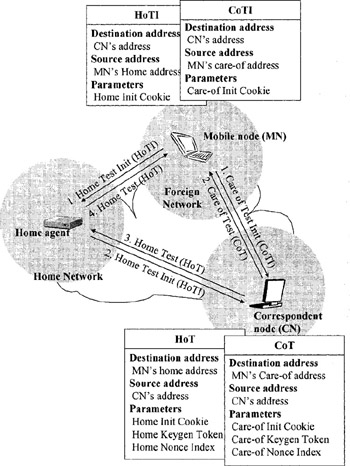
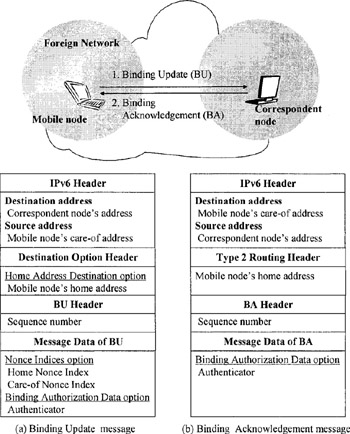
Four messages, such as Home Test Init (HoTI), Home Test (HoT), Care-of Test Init (CoTI), and Care-of Test (CoT), are used in the return routability procedure. Home Test Init and Care-of Test Init messages are sent simultaneously...