Interest rates have a considerable bearing on share prices. Any investor's experience shows that, in general, when interest rates fall, share prices rise, and vice versa.
In this chapter, we will begin by observing the evolution of interest rates in recent years in the United States and other countries, followed by the evolution of interest rates with different maturities. We will then show the relationship between the evolution of interest rates and the S&P 500 and the relationship between interest rates and the PER. We will also show the relationship between interest rates and the dividend yield.
7.1. EVOLUTION OF INTEREST RATES
Figure 7.1 shows the evolution of the interest rates on 10-year Government bonds in the United States, Japan, Spain, and Germany. It can be seen that interest rates in the United States have fallen from 9% in early 1989 to 5% in mid-1993. Subsequently, interest rates rose to 8% by the end of 1995, from that point, interest rates have varied within a two-point band until they reached 5.5% in June 2001. The evolution of interest rates has been similar in the United States and Germany. Interest rates in Spain were substantially higher than those of the other countries until 1997.
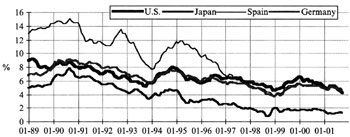 Figure 7.1: Evolution of the yields on 10-year government bonds in the United States, Japan, Spain, and Germany. (Yield on 10-year government bonds.) ( Source: Datastream.)
 In June 2001, the 10-year risk-free interest rates in the United States and the European countries were around 5.5%. Another...
Copyright Elsevier Science (USA). 2002 under license agreement with Books24x7

 TABLE OF CONTENTS