Voice and Speech Quality Perception: Assessment and Evaluation

Speech quality is, in a mathematical sense, a function with several variables. It is related to perception, motivation and attentiveness, subjectivity, perspectives, selection, construction and memory, knowledge, experience, expectations, the brain and the nervous system (cf. [105], [208]).
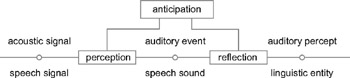
To remove the anonymity surrounding the assessment process, important aspects illustrated by models will first be discussed by posing epistemological and theoretical questions generally and measurement-based questions specifically. The following model for auditory perception is taken as the basis (cf. [93]):
[105]Hellbr ck J, Ellermeier W (2004) Horen. Physiologie, Psychologie und Pathologie. (engl.: Hearing. Physiology, psychology and pathology) Hogrefe, Gottingen, 2nd ed.
[208]Pisoni D B, Remez R (2004) The handbook of speech perception. Blackwell, Oxford
[93]Guski R (1996) Wahrnehmen - ein Lehrbuch. (engl.: Perceiving - a text book) Kohlhammer, Stuttgart
[20]Blauert J, Jekosch U (1996) Sound-quality evaluation - a multi-layered problem. In: acta acustica, 83, pp 747 753
Before carrying out voice and speech quality assessments, one first has to consider the prerequisites and conditions of perception and cognition. Irrespective of the type of object to be perceived, there are various attempts to explain the processes of perception and cognition that relate to the basic question of how we perceive the world and how we recognize and understand it. The scientific field that deals with comprehension, cognition and knowledge is epistemology. Epistemological theory provides particularly fruitful impulses for this work. Anyone...