Wills' Mineral Processing Technology: An Introduction to the Practical Aspects of Ore Treatment and Mineral Recovery, Seventh Edition
The true flotation response has dominated the flotation literature since the separation process was first commercially used in 1905. Jowett (1966) first noted the recovery of fine particles by entrainment in water. Since then measuring techniques and mathematical models to measure and represent the entrainment mechanism have been developed by a number of authors. However, little work has been carried out in industrial scale cells. An exception was research conducted by Johnson (1972) which included industrial cell data to supplement laboratory data. This work showed that the recovery by entrainment is proportional to the feed water recovery to the concentrate. From this finding, the degree of entrainment was defined as the ratio of the recovery of entrained solids to that of water.
Johnson (1972) also showed that the degree of entrainment was a strong function of particle size: entrainment has been shown to be significant below particle sizes of 50 ?m (Smith and Warren, 1989). Recently, Savassi et al. (1998) developed an empirical model to describe the relationship between the degree of entrainment and particle size. This model is represented in the equations below:
| (12.30) | |
and
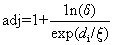
| (12.31) | |
where ENT i = mass transfer of entrained particles to the concentrate mass transfer of water to the concentrate; d i = particle size ( ?m); ? = entrainment parameter, or the particle size for which the degree of entrainment is 20% ( ?m); ? = drainage parameter, related to the preferential drainage...