Active Matrix Liquid Crystal Displays

A definitive guide to the theory and applications of AMLCDs, this book contains numerous design and applications examples to help illustrate key points and make them relevant to real-world engineering tasks.
 TABLE OF CONTENTS
 The image quality and small form factor of TFT LCDs has allowed their application in numerous portable devices as well as in desktop monitors and LCD television. This chapter first describes the basic principles of photometry and colorimetry used to characterize AMLCDs, followed by a description of the basic characteristics of standard AMLCDs in terms of viewing angle behavior, brightness, response time, size, and resolution.
Electronic displays generate images in the visible spectrum that are transferred to the eye and the brain. The visible spectrum (or light) is one form of electromagnetic radiation, with wavelengths in the range of 380 780 nm. The intensity of electromagnetic waves or photons can be expressed in radiometric units such as mW/cm 2.
The following explanation of brightness and color in displays is basic and approximate. For a much more thorough and accurate treatment, the reader is referred to one of the many excellent books on this topic [1] , [2] , [3].
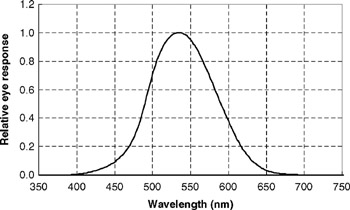
The human eye is sensitive to only part of the electromagnetic spectrum (the "visible" range), as shown in the eye response (or photopic spectral luminous efficiency) curve V( ?) of Fig. 5.1. While radiometry addresses the measurement of radiation in any part of the electromagnetic spectrum, photometry focuses exclusively on the visible light range.
The quantitative measure of display brightness is luminance Lum. It is expressed in photometric units:
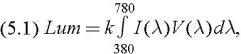
where I(