Active Matrix Liquid Crystal Displays

A definitive guide to the theory and applications of AMLCDs, this book contains numerous design and applications examples to help illustrate key points and make them relevant to real-world engineering tasks.
 TABLE OF CONTENTS
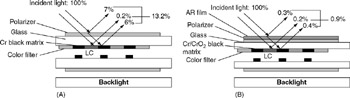
 A unique feature of LCDs is their potential for very low reflectance as compared to emissive displays such as CRTs, plasma displays, and electroluminescent displays. This makes the LCD the display of choice when sunlight readability is required in high-end or out-door applications. However, this feature is not automatic; it needs some special steps in the manufacturing process. Without these special steps, specular reflectance is not particularly low (Fig. 6.9A). A Cr black matrix reflects about 6% and the polarizer about 7%, for a total reflection of more than 13%.
The effective contrast ratio CR eff under ambient lighting is significantly reduced when there are reflections from the display:

where A 0 is the ambient light intensity, I o is the transmitted light intensity for a fully white driven area on the display, R is the reflectance of the display (which is independent of the display image content in a first approximation), CR 0 is the contrast ratio in the dark, and I 0/CR 0 is therefore the luminance transmitted for a fully OFF dark pixel in the absence of ambient light.
R can be the specular reflectance causing glare, in which case CR eff is the specular contrast ratio under an angle complementary with the incident...