Business Process Management Applied: Creating the Value Managed Enterprise

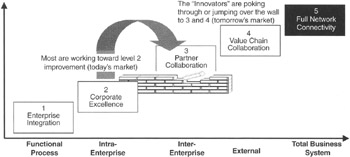
In Figure 1.1, a supply chain maturity model is used to describe the typical progression, through which a firm evolves on its way to the most desired advanced level of implementation. Many firms in many countries have used this model to understand the logical progression of a supply chain effort. The model is also useful to calibrate a firm's position as it moves forward and to determine to what level of progress the company should aspire, especially when the model is extended to the various business functions. Implicit in the use of the model is the understanding that a firm must progress through the levels, none of which can be skipped, although some firms might have business units with footprints in various levels at the same time.
To begin, a firm typically launches its supply chain effort by bringing whatever existing improvement effort is being pursued under an umbrella type of orientation focused on the end-to-end processing that constitutes the organization's supply chain. In this first level of the progression, the firm begins to focus on functional processes, particularly sourcing and logistics. In addition to using these two areas of attention to gather early improvement and quick profit gains, a secondary goal is to bring enterprise integration into focus as an objective within the organization. That means most companies find, as they begin integrating their existing improvement efforts with the overall attention to supply chain, that there is...