Cisco Security Specialist's Guide to PIX Firewalls

Your complete guide to Cisco's PIX Firewalls.
 TABLE OF CONTENTS
 One of the most important features of all firewalls is their ability to intelligently handle many different protocols and applications. If all our needs were satisfied by devices that simply allow, say, outgoing connections to port 80 (HTTP) and deny incoming connections to port 139 (NetBIOS), the life of a security engineer would be much simpler. Unfortunately, many applications, some of which were developed even before the idea of a firewall emerged, act in a much more complicated manner than Telnet or HTTP. One of earliest examples is File Transfer Protocol, or FTP (which we discuss in detail in the next section). The general problem these applications pose is that they use more than one connection to operate and only one of these connections occurs on a well-known port, while the others use dynamically assigned port numbers, which are negotiated in the process of communication. Figure 4.1 shows an example of what happens when this situation occurs and no special measures are in place. (This is a simplified example of SQL*net session negotiation.)
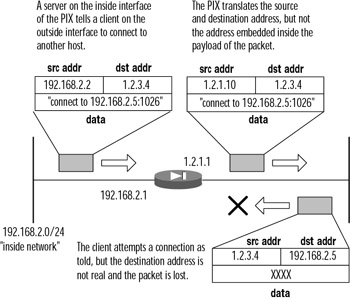
Thus, any firewall that wants to handle these negotiations well needs the ability to monitor them, understand them, and adjust its rules accordingly. This situation becomes even more complicated when NAT or PAT are involved; the firewall might need to change the data portion of a packet that carries embedded address information in order for the packet to be correctly processed by a client or server...