Computer Systems Performance Evaluation and Prediction

Memory storage volume is always looked at as an important feature when one thinks about acquiring a computer system. Whether the system is a desktop personal computer, a workstation, or a large special-purpose processor, data storage has always been a major selling point and a requested feature. As the price of memory has come down, the size of memory purchased for all classes of computers has gone up. One nonchanging feature is the general structure of the memory hierarchy. No matter how sophisticated or how simple the systems are, we will find that they all have something in common. The designers of the systems have organized data storage to maximize performance and provide adequate information volume storage.
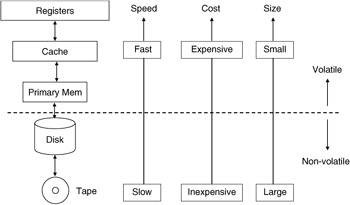
The storage hierarchy (Figure 2.6) consists of a variety of data storage types that respond to the information needs of the system. From the highest-speed element (a cache) to the slowest-speed elements (archival devices), the tradeoff is the cost and speed of the storage medium per unit of memory. What is being attempted is to match the speed of the computer processor with the highest-speed devices within a reasonable cost curve. In the following sections we will examine the information storage devices outside of the central processing unit realm. This leaves out the high-speed expensive cache memories and primary memory. We will begin our review by looking at tape devices, magnetic disks, and archival devices.
Magnetic tape...