Computer Systems Performance Evaluation and Prediction

A computer systems based application requires services and cooperative support from a collection of computer hardware and software to perform its designated function. The application requires a computational platform consisting of a CPU, memory, and secondary data storage, as well as a supporting operational infrastructure consisting of an operating system, database management system, network management, and additional process and resource management components. To understand how a computer-based application utilizes these components we must first understand the operation of these software infrastructure elements.
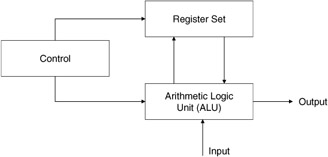
The central processing unit (CPU) and the main memory make up the basic computational engine and support the execution of all software within this computer. The CPU is composed of a collection of registers, computational subunits, data paths, and status registers that are used to move data about and to perform basic manipulations on these data (Figure 2.17). For example, a CPU can add, subtract, multiply, divide, and compare values or simply move them from one location to another. These are basic operations, which the remainder of the system's infrastructure is built upon and where it resides. The CPU also includes some additional support hardware, such as timers, interrupt registers and latches, input and output registers, and interconnections. For additional details on these elements refer to previous sections in this chapter.
In addition to the CPU, the other primary element within the basic system is the memory. A memory hierarchy is typically comprised of high-speed data registers, fast cache...